New plant · Extension · Retrofit
Your plant takes 30 months. The AI to run it changes every 6.
The decisions that govern what artificial intelligence will be able to do inside your factory are signed between month 4 and month 20, and they do not reopen without stopping production. We tell you which ones apply to you, and which you are still in time to change.
What we are not
Not an EPC, not the design engineer, not an integrator. On your project we have no scope to defend and no commission from any vendor.
Where we sit
On your new-facility committee, beside your engineering lead, before the concept design is frozen.
Frameworks we apply
AI Act · NIS2 · IEC 62443 · Data Act · GMP/CSV. Applied to your sector and your phase, not in the abstract.
The short answer
A plant opening in 2029 is specified with what is known in 2026. Five decisions — contracted power, floor loading, cable trays, network and data ownership — are signed in basic engineering and never come back. There are only five, they can be listed, and in almost every project at least one is still open.
Find yourself
Which of these three is your project?
The same underlying problem, completely different decision windows. The call changes depending on which one you are.
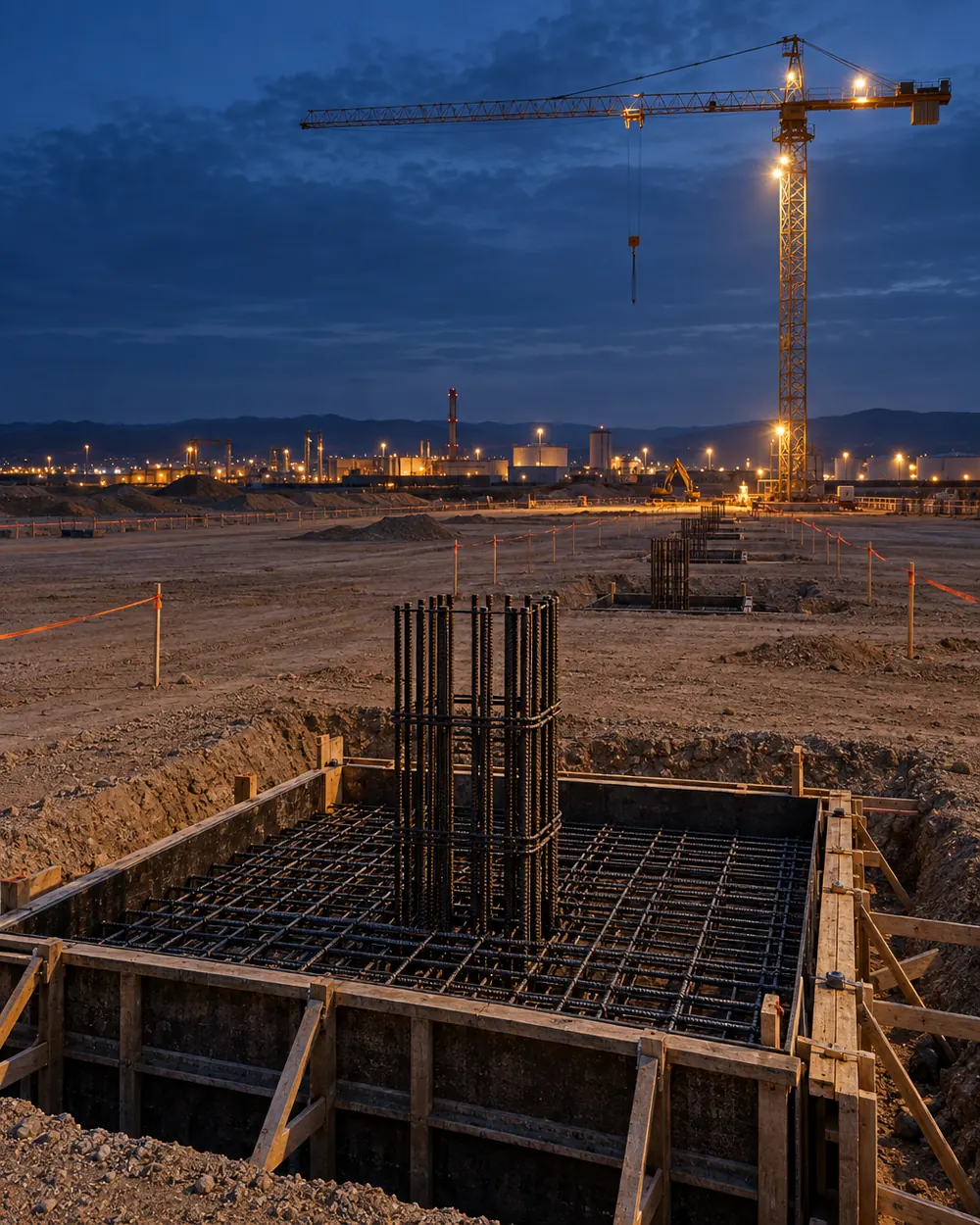
New plant
You decide everything, and nearly all at once
Electrical envelope, floor loading and network topology are fixed in basic engineering, when nobody has yet thought about what will run inside in 2031.
See what you decide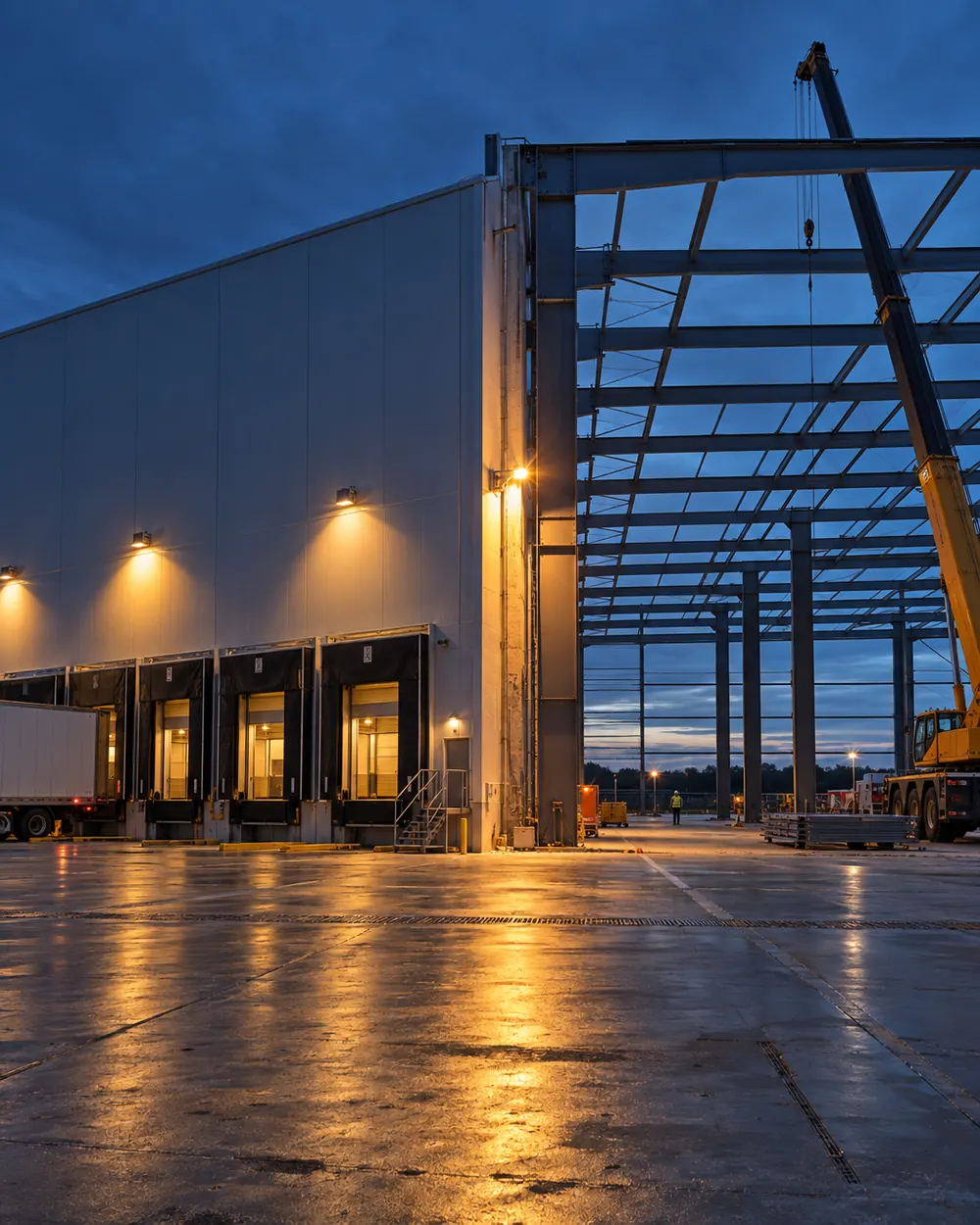
Extension
You inherit a plant and tie another one to it
The junction decides whether the new building gets its own data standard or drags along the one from fifteen years ago.
See what you decide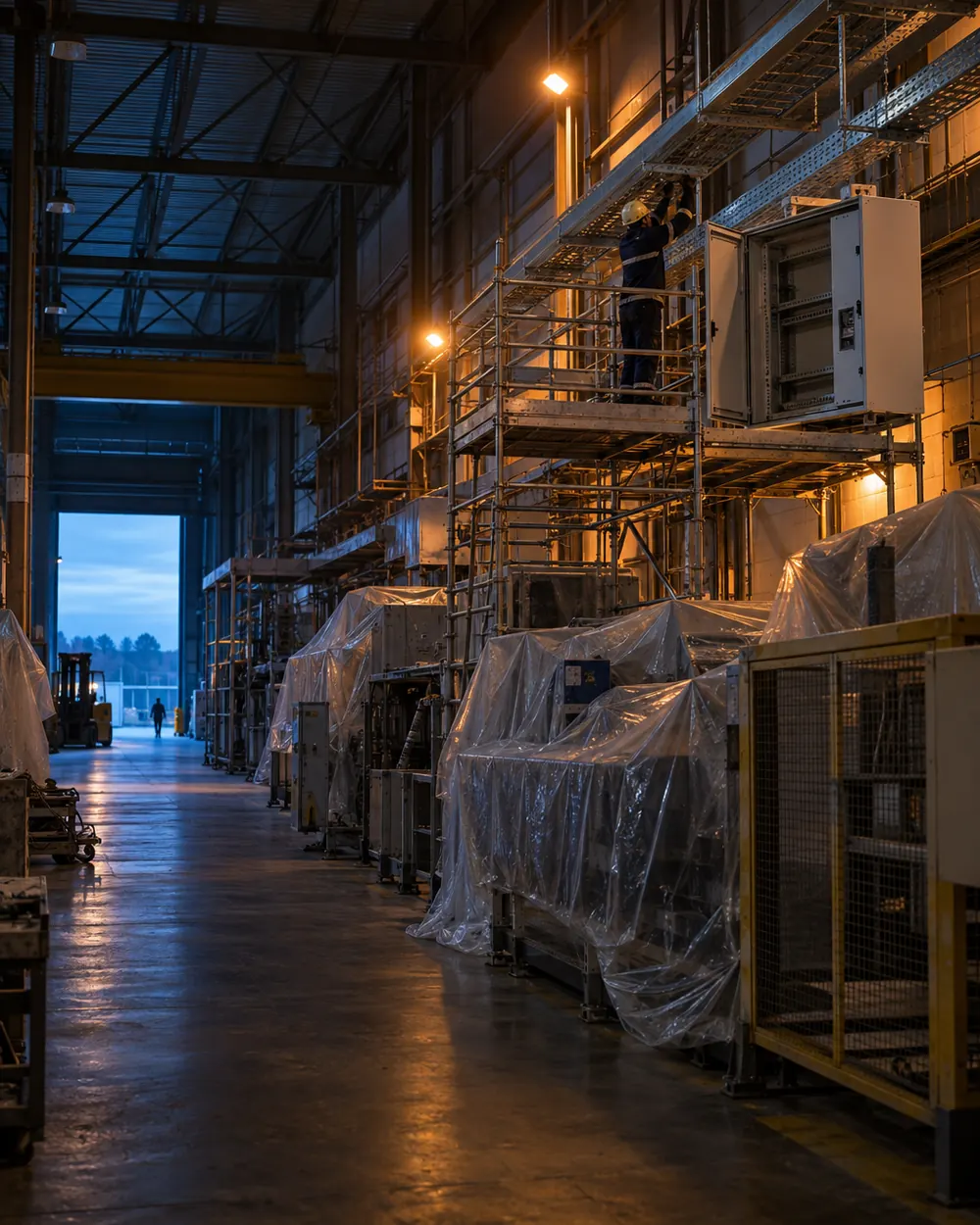
Retrofit
The expensive part is not the equipment, it is the shutdown
Whatever is not prepared during this shutdown waits for the next one, years away. An empty conduit costs a hundred euros now.
See what you decide
The irreversible part
The five decisions that never come back
Of the hundreds of decisions in a project, nearly all can be corrected. These five cannot — not without stopping production.
-
01
Contracted power
Requested in month 2 and sized against year-one consumption. On-site compute never appears in that spreadsheet, because at that point it has no owner.
-
02
Floor loading and structural openings
What is not in the structural drawing is not freed up later without touching concrete, and touching concrete in a running plant is a shutdown.
-
03
Cable trays and conduit
The cheapest decision of the five and the most regretted. An empty conduit costs what the conduit costs; opening one later costs the whole shutdown.
-
04
Network topology and zoning
Segmenting to IEC 62443 with the plant stopped is project work; with the plant producing it is another project, with a shutdown of its own.
-
05
Data ownership
Decided without being decided, inside equipment purchasing specifications. If process data leaves encrypted towards the vendor, there is no in-house model to train later.
From site to SOP
What closes in each phase, and when it stops being touchable
Site and permits
Power, water and fibre. The grid connection is fixed for the life of the plant.
Construction and services
Floor loading, openings, trays. Everything that would later be concrete.
Automation and OT
PLC, SCADA, IIoT. And, in the specs, who owns each machine's data.
Cybersecurity and data
NIS2 and IEC 62443 zoning. Segmenting while producing costs ten times more.
Commissioning and CSV
IQ/OQ/PQ that still hold with a model in the control loop.
Ramp-up and steady state
Throughput, first-pass yield, predictive maintenance.
No small print
Exactly what happens when you request the call
We spell it out because this is the part that creates most distrust, and rightly so.
1
You fill in three fields
Project type, phase and email. No phone number, no company, no NDA: we do not need your drawings for this.
2
An engineer writes within 48 h
From info@newaifactory.com, to book thirty minutes whenever suits you. There is no email sequence and no sales follow-up.
3
You keep the written summary
The decisions your phase is closing, what each costs to reopen, and what to ask your EPC this week. Whether you hire us or not.
Before writing to us
Questions we always get
My plant is already under construction. Am I too late?
For some things yes, for others no, and that is exactly what the call tells you. On site you can still move trays, rack space and network architecture; the electrical connection and the structure, no longer. Knowing which of the two groups each item is in is the whole exercise.
I already have engineering and an EPC under contract. Why would I need you?
Your EPC is paid to deliver the scope you signed, and normally delivers it well. What is not in their contract is asking whether the scope was the right one, because you settled that before hiring them. We have no scope to defend, so we can ask.
Where is the catch in a free call?
There is none, but asking is the sensible thing. We live off a fraction of those calls turning into an advisory engagement with the committee. Most lead nowhere, and that is fine: it is the price of the call being worth anything. We do not build, we do not integrate, and we take no commission from any vendor on the project.
Does it work the same for pharma, food and automotive?
The six-phase structure does not change. The detail does, above all in validation: in pharma a model inside the control loop is a first-order regulatory problem, and in automotive it is an engineering decision.
If your project has it all buttoned up, we tell you that too.
It is the cheaper of the two outcomes, and it happens more than you would think.